Trenchless Sewer Repair in Phoenix, AZ
Fix a cracked, root-filled or corroded sewer line through one or two small access pits instead of a trench across your yard, driveway or desert landscaping. Call and we connect you with a licensed Valley sewer contractor who cameras the line first and tells you whether trenchless will actually work.
Phone lines open Mon to Sat, 7am to 7pm
What trenchless sewer repair is
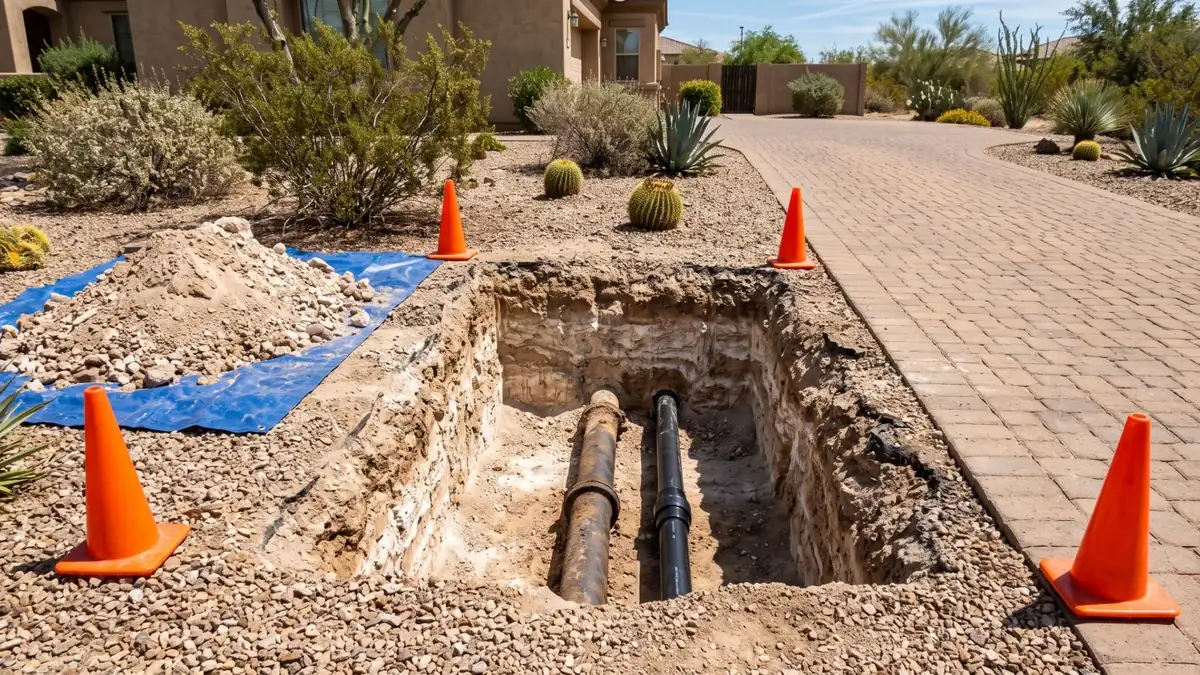
Trenchless repair rebuilds or replaces the pipe from the inside, so the crew only digs where they need access: usually a cleanout near the house and, for some methods, one pit near the property line or in the yard. The old pipe stays in the ground. Either a new pipe is formed inside it (lining) or a new pipe is pulled through as the old one is broken apart (bursting).
It matters in Phoenix because a lot of sewer laterals run under things that are expensive to rebuild: pavers, concrete driveways, decomposed granite with drip irrigation, mature citrus, block walls and pools. A traditional open trench means cutting through all of it and putting it back afterward.
The two main methods
Rebuilds the pipe inside
Pipe lining (CIPP, cured-in-place pipe)
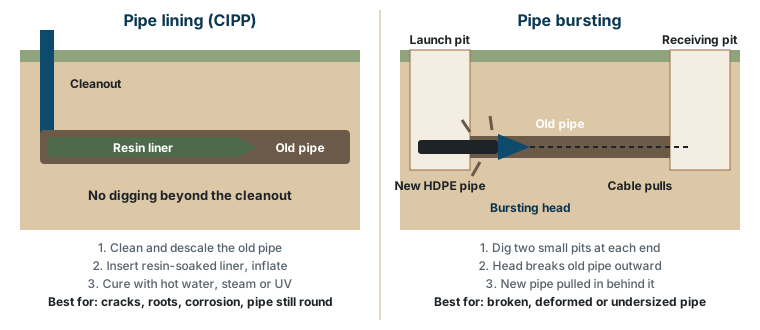
The line is cleaned with a hydro jetter or descaling cutter, then a resin-soaked felt liner is pulled or inverted into the old pipe and cured with hot water, steam or UV light. The result is a seamless pipe inside the old one. Lining fits pipes that still hold their shape: cracks, root intrusion at joints, corroded cast iron, pinholes. A robotic cutter then reopens any side connections from inside. Lining is often the only practical option for cast iron drains under a slab, because it avoids jackhammering floors.
Replaces the pipe in place
Pipe bursting
A cable is fed through the old pipe from a launch pit to a receiving pit. A cone-shaped bursting head pulls a new high-density polyethylene (HDPE) pipe through behind it, fracturing the old pipe outward into the soil. Bursting fits pipes that are too far gone to line (heavily deformed Orangeburg, badly broken clay) and can upsize the line. It needs two pits and room around the pipe, so it is less suited to lines hugging other utilities.
- Spot repair / sectional liner: a short liner (a few feet) over one bad joint or crack. Cheapest trenchless fix when the camera shows the rest of the line is sound.
- Descaling plus lining: cast iron often has heavy scale that must be ground out before a liner will seat.
Which method fits which pipe: the comparison nobody publishes
The camera inspection decides this, not the sales pitch. Here is how the options line up for the pipe problems we see around the Valley. Price ranges are from published Phoenix and national cost guides; your quote depends on length, depth, access and how many connections the line has.
Swipe table →
| Method | Fits when the camera shows | Digging | Typical cost | Wrong choice when |
|---|---|---|---|---|
| CIPP lining | Cracks, roots at joints, corrosion, pipe still round | Usually none beyond a cleanout | $80 to $250 per ftPhoenix | Pipe is collapsed, flattened or has a deep belly holding water |
| Sectional / spot liner | One or two bad spots, rest of line sound | None to one small pit | $600 to $1,050for a spot repair (national) | Damage is spread along the line |
| Pipe bursting | Broken, deformed or undersized pipe; Orangeburg that has flattened | Two pits (launch and receiving) | $60 to $200 per ftnational | Gas, water or electric lines run tight alongside; many side connections |
| Open trench | Collapsed sections, severe bellies, grade that must be corrected | Full trench along the line | $45 to $280 per ftall-in (Phoenix replacement range) | Line runs under slab, pool deck or mature landscaping you want to keep |
Sources: Angi, Phoenix sewer line cost, HomeGuide, sewer line repair cost. Checked September 2026.
Why Phoenix sewer lines fail
Older pipe materials
About 40% of housing units in the city of Phoenix were built before 1980, roughly 271,600 homes and apartments (Census ACS 2024). Homes from the 1940s through the 1960s were built when cast iron and Orangeburg (tar-coated fiber pipe) were common for the line from the house to the street. Orangeburg typically lasts about 50 years and can fail sooner; it flattens as it softens (KTAR, City of Tempe).
Roots
The City of Phoenix names roots from trees and shrubs, including oleanders, as the second biggest cause of sewer blockages after grease. Roots get in through joints and grow into root balls (Phoenix Water Services).
Soil movement
The Arizona Geological Survey says the state's geology and semi-arid climate create near ideal conditions for expansive and collapsing soils, and lists ruptured pipelines among the damage they cause (AZGS). Wet monsoon storms after long dry spells make that cycle worse.
How a trenchless job runs, step by step
- Camera inspection and locate. A camera goes in through the cleanout; a transmitter on the camera head lets the tech mark the line's path and depth on the surface. You should get the video.
- Clean the line. Hydro jetting or mechanical cutting removes roots, grease and scale so the liner or bursting head can pass.
- Permit check. Replacing a sewer line generally requires a plumbing permit and inspection in Valley cities; Tempe and Glendale say so explicitly. The contractor should pull it.
- Line or burst. Most residential jobs finish in a day once the line is prepped.
- Final camera. A second video should show the new pipe from end to end, with side connections reopened. Ask for it in writing.
When trenchless is the wrong call
A good contractor will tell you when trenchless will not work. The common cases: the pipe has fully collapsed so nothing can pass; a belly (sag) holds standing water, which a liner would just follow; the line has so many connections that each reopening adds cost and risk; or bursting would push toward a gas or water line. In those cases an open trench on the bad section, sometimes combined with lining the rest, is usually the honest answer.
What trenchless sewer repair costs in Phoenix
Published ranges for the Phoenix area. Two local contractors publish their own Phoenix ranges of about $3,500 to $8,500 and $4,800 to $12,000 for typical residential trenchless jobs, which tells you real quotes often land above the averages below once cleaning, access and restoration are included.
Swipe table →
| Job | Typical range | What moves the price |
|---|---|---|
| Trenchless replacement (whole job) | $1,963 to $6,198avg. $2,996 | Length of line, depth, number of access pits |
| Trenchless per foot | $64 to $260 per ft | Lining vs bursting, pipe diameter |
| CIPP lining per foot | $80 to $250 per ft | Cleaning or descaling needed first, reinstated connections |
| Pipe bursting per foot | $60 to $200 per ft | Soil, depth, nearby utilities (national figure) |
| Camera inspection | $245 to $350 | Under 50 ft with an accessible cleanout |
Sources: Angi, Phoenix trenchless cost, Angi, Phoenix sewer line cost, HomeGuide. Checked September 2026. Your contractor sets the actual price after inspecting.
Trenchless Sewer Repair: common questions
Do I have to dig up my yard for trenchless repair?
Usually not. Lining often needs only the existing cleanout. Bursting needs a launch pit and a receiving pit, each a few feet across. The crew backfills them; hardscape over a pit is patched, not rebuilt.
How long does a lined pipe last?
Liner manufacturers commonly rate CIPP for about 50 years. Ask the contractor for the product name and written warranty terms rather than relying on a general claim.
Can a cast iron line under my slab be lined?
Often yes, and it is the main reason people choose lining in Phoenix slab homes. The pipe must be descaled first and still hold its shape. The camera tells you.
Does homeowners insurance pay for trenchless repair?
Standard policies usually exclude wear, tree roots and deterioration. Sudden damage may be different. Separate sewer line warranty plans exist: the City of Phoenix partners with American Water Resources for optional plans. Read the exclusions; a Tempe homeowner was denied an $11,000 claim over tree roots being called pre-existing.
Is trenchless always cheaper than digging?
Not always on a short, shallow, open run. It usually wins once you add the cost of restoring pavers, concrete, landscaping or anything under a slab.
Related services
Sewer Camera Inspection
See inside the line before you buy a home or pay for a repair. Video plus a plain-English read of what it shows.
Read the guide →Sewer Line Replacement
When the pipe is past repair: trenchless or open-trench replacement, what goes in the quote, and how to compare bids.
Read the guide →Sewer Line Repair
Backups, gurgling drains, sewage smell. Find the cheapest fix that actually works, from cleaning to a spot repair.
Read the guide →Also available in Tempe, Glendale, Scottsdale, Mesa.
Serving Phoenix and the surrounding Valley
We connect homeowners across the Phoenix metro with licensed local sewer contractors: central Phoenix and Ahwatukee, plus Tempe, Scottsdale, Mesa and Glendale.
Also covering: Chandler, Gilbert, Peoria, Paradise Valley, Sun City.